About the 2nd edition of the Santa Fe to Taos Trail Guidebook
June 25 update:
The 375 copies I ordered have been printed and will arrive Monday, June 29th.
If you ordered the first edition and are waiting for your backorder, it will ship out Monday afternoon.
If you are in Santa Fe, and ONLY if you are a SF2T member or you placed an order before, you can pick up one of the 17 copies I have now at the Friday pickup party. I’ve got 17. First come, first served.
The GPX file with the 2026 route is done.
I am preparing the EPUB file (aka “Kindle book version”) of the second edition, but it will take at least a week to finish.
Thank you for your patience. To everyone who was kind while my mother was in the hospital: Thank you.
What delayed the second edition of the guidebook by a month?
Most of why it’s not done is because a) just managing the basic day-to-day of the SF2T is 80+ hours a week and b) the SF2T has tipped into a serious overuse situation and getting ahead of that took temporary priority over finishing the guidebook. 600 or more thru-hikers will do the SF2T this year. The high alpine lakes, in particular, are at risk of adverse impacts.
For those of you who bought the guidebook after the first edition cutoff (February 21st), you will get your guidebook, and if you want a digital version, please see the email I’ve sent you. If you want to cancel your order, use the contact form and tell me the email address you used to order the guidebook.Here are answers to the most common questions I’ve been getting about the guidebook:
What’s in the second edition?
- The new alternate routes in the north half of the SF2T. These cut “road walking” (forest service road walking) in half.
- Significantly updated and expanded logistics information.
- Way more detailed information about campsites, with campsites included in the section maps.
- Way more detailed information about water sources, with water sources included in the section maps.
Do you need the second edition to do the SF2T?
No. You’ll miss the new parts in the north half that skip the forest roads, but you can still do the SF2T.
Will there be a digital version of the second edition?
Yes. An EPUB file. That’s the same file format Kindle books use. So you’ll be able to import the EPUB file into Kindle devices, the Kindle app, or any of the many other reading apps available.
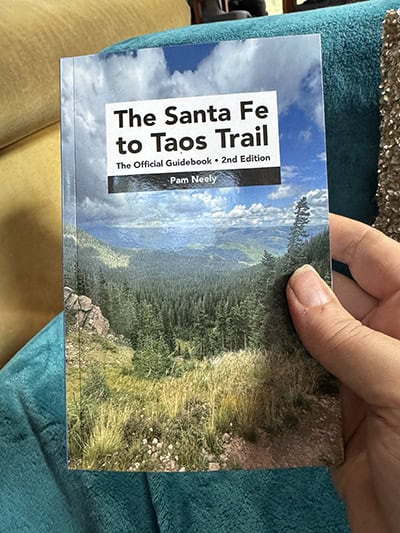
What will the cover look like?
Okay, so nobody is actually asking that. But it’s a good segue into letting you pick which cover you like best.
A bit more about this overuse situation…
I have taken several actions to address this:
- The SF2T registration program is active and working. We have good data that land managers and other entities take seriously. We have an idea of when the traffic spikes might happen. We know, for instance, that over a third of people doing the SF2T are from New Mexico. The SF2T was originally created, and is still primarily for New Mexicans, especially those who live near it.
- A campsite monitoring program has been created and is being field tested. This will allow us to track the conditions of the 130+ campsites along the route. We’re building it so any hiker can complete an easy form and let us know where the problem spots are.
- The SF2T has begun work toward getting Leave No Trace Gold Standard designation as a program. We are already a Leave No Trace Platinum Level Community Partner, and Pam has become a Leave No Trace Level 1 Instructor. See the Leave No Trace page for more about SF2T’s Leave No Trace Partnership. Becoming a messenger for Leave No Trace principles is a natural move for the SF2T. To wit: The first edition of the guidebook talks about Leave No Trace principles both at the beginning and the end of the book.
- Last year I (Pam) got a certificate in Visitor Use Management. I have been concerned about overuse for a long time, even before last fall’s unfortunate publicity surge. I have a draft of a Visitor Use Management plan that I will prioritize and finish as soon as the guidebook is done.
Key thing for everyone to understand, and key part of my job to convey to everyone better:
The primary purpose of the SF2T isn’t hiking. It is to renew our connection to the land. The thing that has driven me (Pam) to create the SF2T is that pull to the mountains so many of us feel. That the SF2T is now required to responsibly handle increased use — and to up its game at managing that use and shaping our messaging — is timely. Our public lands are under unprecedented threats. Our humanness – our ability to connect and be present, to keep our hearts open – is also being covertly taken from us, click by click, frame by frame, distraction by distraction.