
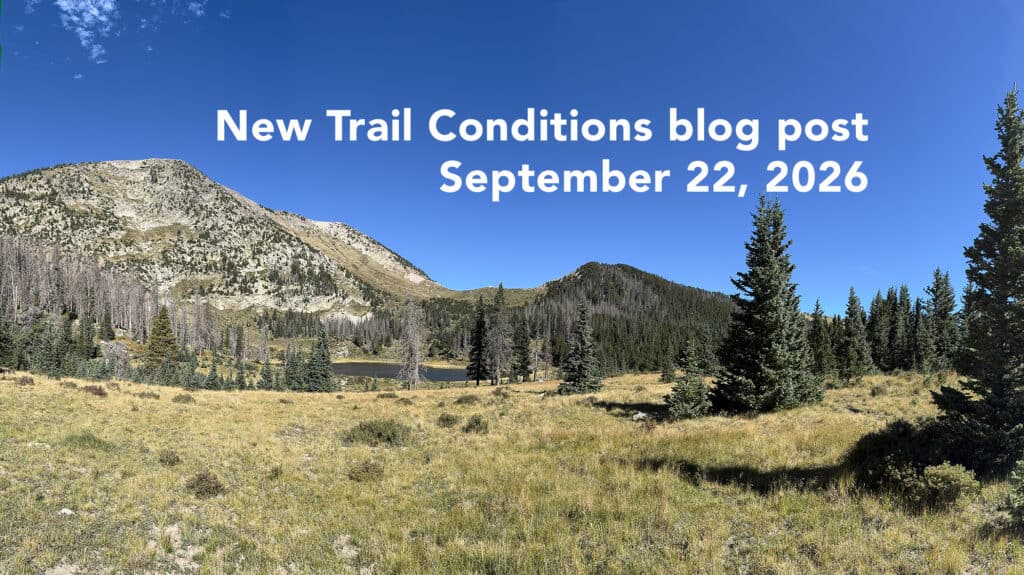
Frijoles Fire closure has ended
The fire is at 15,956 acres and 90% containment as of October 2. All closures have been lifted for several weeks now. Check the Frijoles Facebook page for updates.
Want to get the 2026 SF2T enhanced GPX file for free?
- Take Leave No Trace’s free 101 online course. Takes 30 minutes to complete.
- Send us the PDF of your completion certificate. (contact@santafetotaos.org)
- We’ll send you a coupon code to get the GPX file for free. You’ll also get a tutorial for how to import it into major navigation apps.
Take the course, get the file.
Have a better experience and help the trail. 🙌
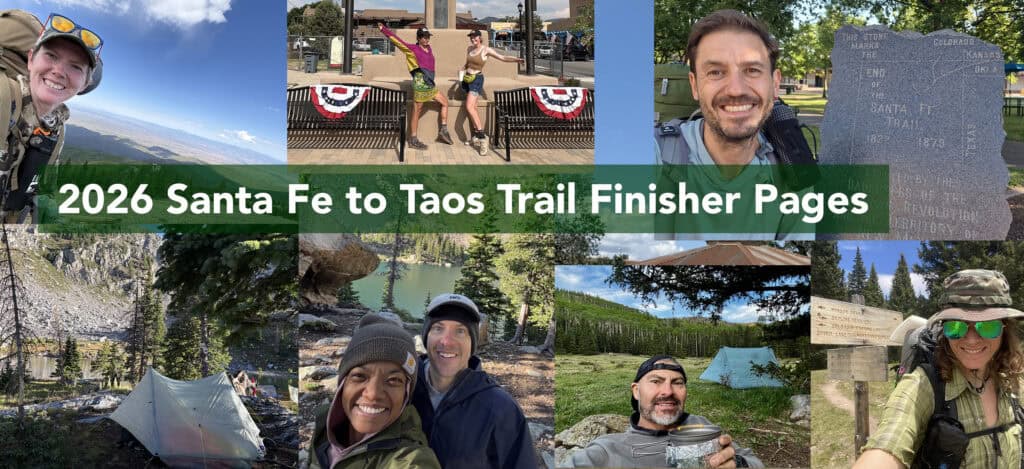
If you come to the Santa Fe to Taos Trail, please come as a steward.
We are not here just to pass through and take from this place, or any place. We are here to care for it, all of it: the lands and waters and wildlife, the communities connected to them, and the trail infrastructure that makes hikes possible.
Thru-hiking is not inherently extractive, but it can become extractive when hikers increase the wear and tear on all the things that make their journey possible without contributing to their care.
That is not said to make anyone feel bad or guilty. It is not necessarily to say, “don’t come here.”
It is said because hikers have responsibilities. We all do.
It is time for more hikers to shift from speeding through and checking trails off their lists to caring for the places, people, and systems that make their journeys possible. Many already do this.
The simplest way to make this shift is to start saying “thank you” more often.
Start saying it when and how you might not have before. Like to the ground you slept on, or the trees you hung your hammock from. To the breeze that cools you, and the sun that warms you. To the water sources that sustain you.
Just saying “thank you” changes the interaction. It changes us, too.
Great things come from small beginnings.
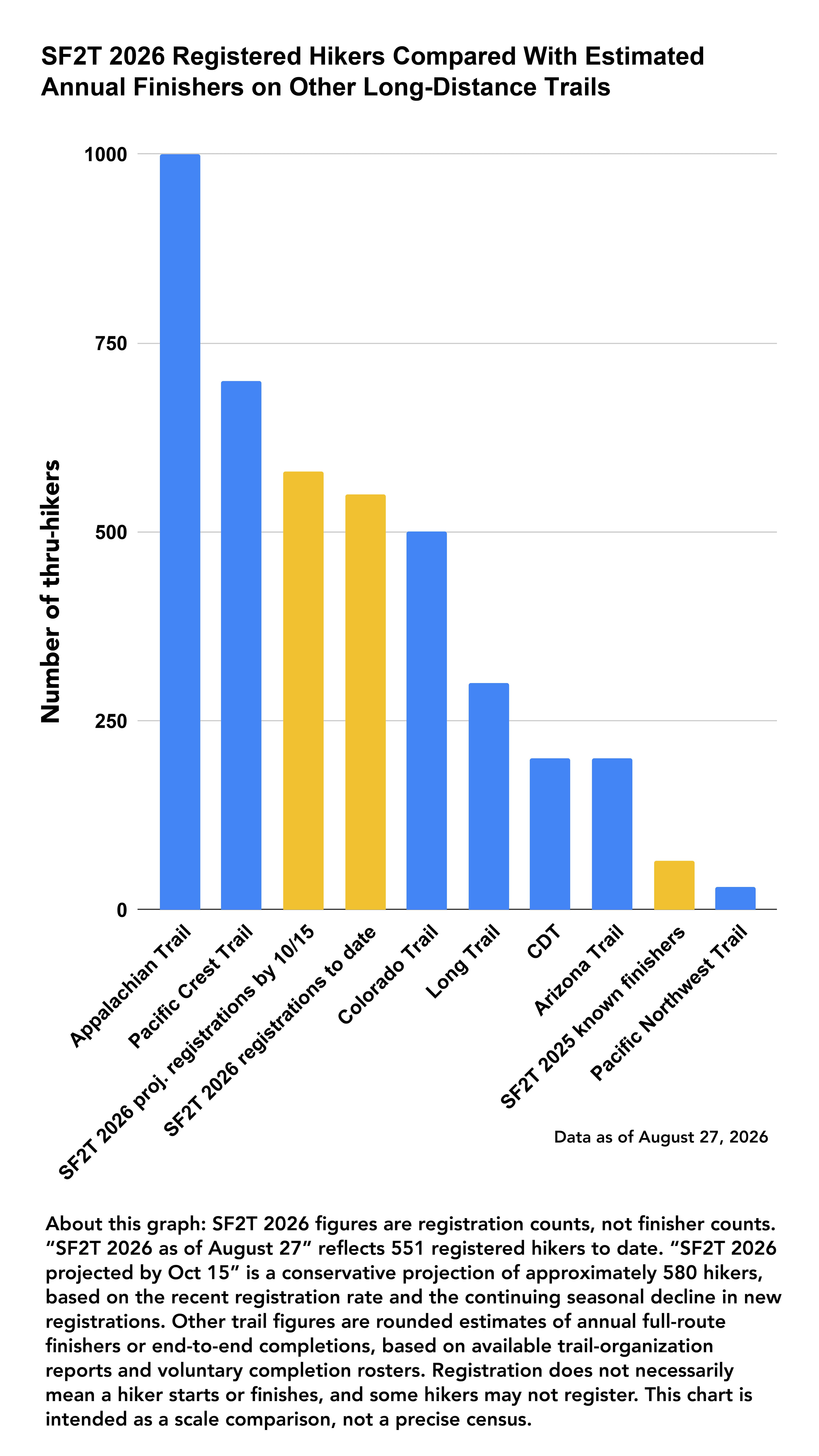
The Santa Fe to Taos Trail is undergoing a massive increase in traffic. We will see 10x as many hikers as last year – probably more hikers than do the Colorado Trail every year, and two to three times as many hikers as do the Continental Divide Trail every year.


The Santa Fe to Taos Trail goes from the Santa Fe Plaza to Taos Plaza over the Sangre de Cristo Mountains of northern New Mexico. It is 132 miles long, spans five counties – Santa Fe, San Miguel, Mora, Rio Arriba, and Taos – and crosses the Santa Fe National Forest, The Pecos Wilderness, and Carson National Forest. The full route has 35,000 feet of cumulative ascent and descent, as both plazas are at 7,000 feet elevation.
The route is over a decade in the making, scouted and refined by Pam Neely beginning around 2014, and then first completed as a thru-hike in 2018. It has been refined several times to optimize safety and access to water. It is still being refined and expanded.
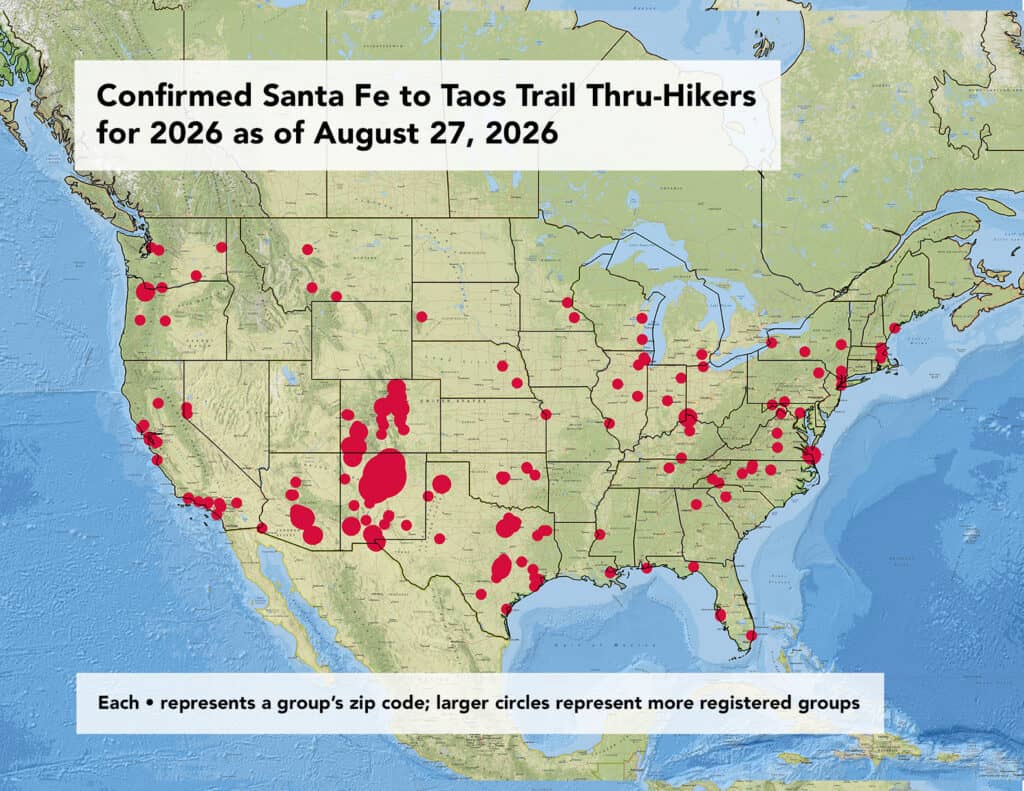
Total registered hikers (as of August 27, 2026, excluding known Frijoles cancellations)
- 286 registered groups
- 549 registered people
- Average group size: 1.9 people
New Mexico hikers
- 93 groups
- 171 registered people
- 32.5% of all groups
- 31.1% of all hikers
Out-of-state U.S. hikers
- 189 groups
- 370 registered people
- 66.1% of all groups
- 67.4% of all hikers
Top states after New Mexico by groups
- Colorado: 44 groups (15.4% of U.S. groups), 88 people (16.0% of U.S. people)
- Texas: 39 groups (13.6% of U.S. groups), 62 people (11.3% of U.S. people)
- Arizona: 24 groups (8.4% of U.S. groups), 59 people (10.7% of U.S. people)
- California: 19 groups (6.6% of U.S. groups), 39 people (7.1% of U.S. people)
International hikers
- Australia: 4 people
- Mexico: 2 people
- Netherlands: 1 person
16 previously registered hikers canceled or postponed their 2026 trips because of the Frijoles Fire. They are not included in these counts.
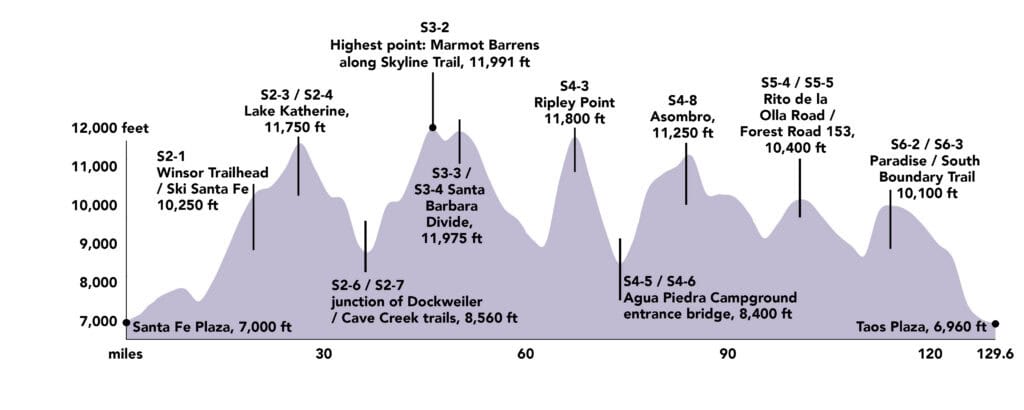
Elevation profile of the 2026 route of the Santa Fe to Taos Trail
Maps and route
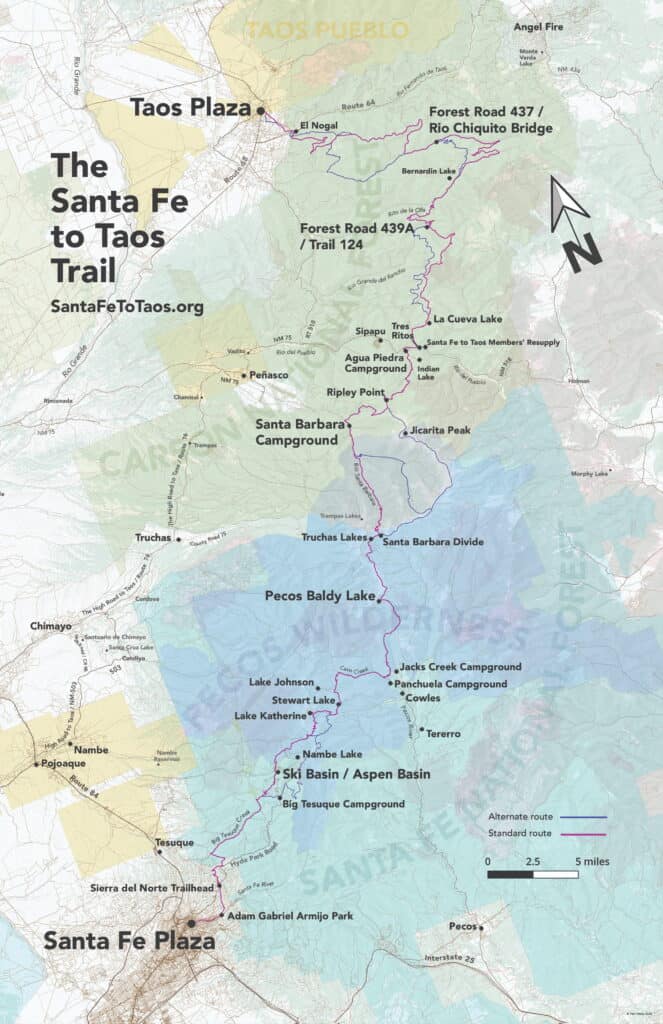
See the route page and individual section pages for details on the route and turn-by-turn directions for the route. (6/22/26: Route page is old info and needs an update)
Presentation at the Los Alamos Mountaineers monthly meeting at the Los Alamos Nature Center Planetarium, Tuesday, October 28th
Huge thanks to the Mountaineers and the Nature Center for this opportunity.
Plaza to Plaza in 52 photographs
Each photograph is from one of the 50 subsections that make up the route.


